
Finding the best deal on insurance or utilities can feel like a maze when every provider claims to offer unbeatable value. Bias often sneaks into our comparisons, whether through familiar brand names or persuasive marketing. Understanding the principles of unbiased comparison is vital for British consumers who want to cut costs and make fair choices. This guide breaks down the essential methods and reveals how to apply them for smarter financial decisions.
Table of Contents
- What Is Unbiased Comparison? Core Concepts
- Types Of Unbiased Comparison Methods
- How Unbiased Comparison Works In Practice
- Benefits For UK Consumers And Risks Of Bias
- Spotting And Avoiding Common Comparison Pitfalls
Key Takeaways
| Point | Details |
|---|---|
| Importance of Unbiased Comparison | Unbiased comparison is crucial for making informed decisions by evaluating options without personal biases affecting the outcome. |
| Principles of Effective Comparison | Consistency, objectivity, transparency, and clear criteria are essential for reliable comparisons across different providers. |
| Risks of Bias | Acknowledging common biases such as confirmation bias and brand loyalty is necessary to avoid flawed decision-making. |
| Utilising Structured Methods | Employing diverse comparison methods, including descriptive and analytical approaches, enhances the robustness of your decisions. |
What Is Unbiased Comparison? Core Concepts
Unbiased comparison means looking at options side-by-side without letting personal preferences or hidden agendas distort your view. It’s the foundation of smart decision-making when you’re choosing insurance, utilities, or any household service.
At its core, unbiased comparison relies on a few essential principles:
- Juxtaposition: placing options directly next to each other to reveal genuine differences
- Objectivity: removing personal bias from the evaluation process
- Consistency: applying the same standards to every option being compared
- Transparency: showing where information comes from and how it was gathered
When you compare broadband providers, for example, you’re not just checking speeds. You’re examining contract terms, customer service ratings, price transparency, and hidden fees using the same criteria for each provider. That’s unbiased comparison in action.
Why Bias Creeps Into Comparisons
Researchers and consumers alike struggle with bias and debiasing strategies in data collection. You might unconsciously favour a brand you’ve heard good things about or dismiss an option because of one negative review.
Common biases that affect comparisons include:
- Confirmation bias: seeking information that supports your existing preference
- Brand loyalty bias: automatically trusting a familiar name over competitors
- Anchoring bias: letting the first price you see distort how you evaluate others
- Recency bias: overweighting recent experiences whilst ignoring longer-term patterns
These aren’t character flaws—they’re how human minds naturally work. The key is recognising them and using structured comparison methods to counteract them.
The Logic Behind Sound Comparisons
Unbiased comparison uses comparative logic to avoid decontextualisation and ethnocentrism in social research. This means understanding not just what differs between options, but why those differences matter in your specific situation.
Imagine comparing home insurance policies. Two policies might have identical premiums, but one covers accidental damage and the other doesn’t. Without context, the prices look the same. With context, you see a meaningful difference.
A proper comparison asks:
- What criteria actually matter for my situation?
- Where did this information come from?
- Am I using the same measurement for every option?
- Have I considered information I might have overlooked?
- Is my conclusion based on facts or assumptions?
Unbiased comparison transforms raw data into actionable insight by applying consistent standards and questioning your own assumptions.
How Wise Choice Comparisons Applies These Principles
When finding better deals faster, the platform consolidates quotes from regulated providers, removing the need for you to contact each company separately. This structural approach reduces bias by presenting options uniformly, without marketing language clouding the comparison.
You see actual prices, actual coverage terms, and actual customer data—not what companies want you to focus on.
Pro tip: When comparing options, write down your must-haves and nice-to-haves before reviewing quotes. This discipline prevents switching criteria mid-comparison, which is where most biased decisions happen.
Types Of Unbiased Comparison Methods
There’s no single way to compare options fairly. Different situations call for different approaches, and knowing which method works best helps you make stronger decisions about insurance, utilities, and household services.
Descriptive Comparisons
Descriptive comparison simply lays out the facts about each option without trying to explain why differences exist. You’re characterising what you see, not making causal claims.
When comparing home insurance providers, a descriptive approach shows:
- Premium costs for identical coverage levels
- Excess amounts and what they cover
- Customer service response times
- Available add-ons and optional extras
This method works well when you need a straightforward overview. It answers the question: “What are my options?” rather than “Which is best for me?”

Analytical Comparisons
Analytical comparison goes deeper by exploring relationships between options and testing which factors actually matter. You’re not just describing; you’re understanding causation.
With analytical methods, you might ask: Does a higher premium genuinely correlate with better customer service? Does the cheapest broadband provider actually have the slowest speeds? Analytical comparisons explore relationships and test hypotheses by examining observational data or patterns across multiple providers.
This approach takes more effort but gives you stronger reasoning for your final choice.
Qualitative vs. Quantitative Methods
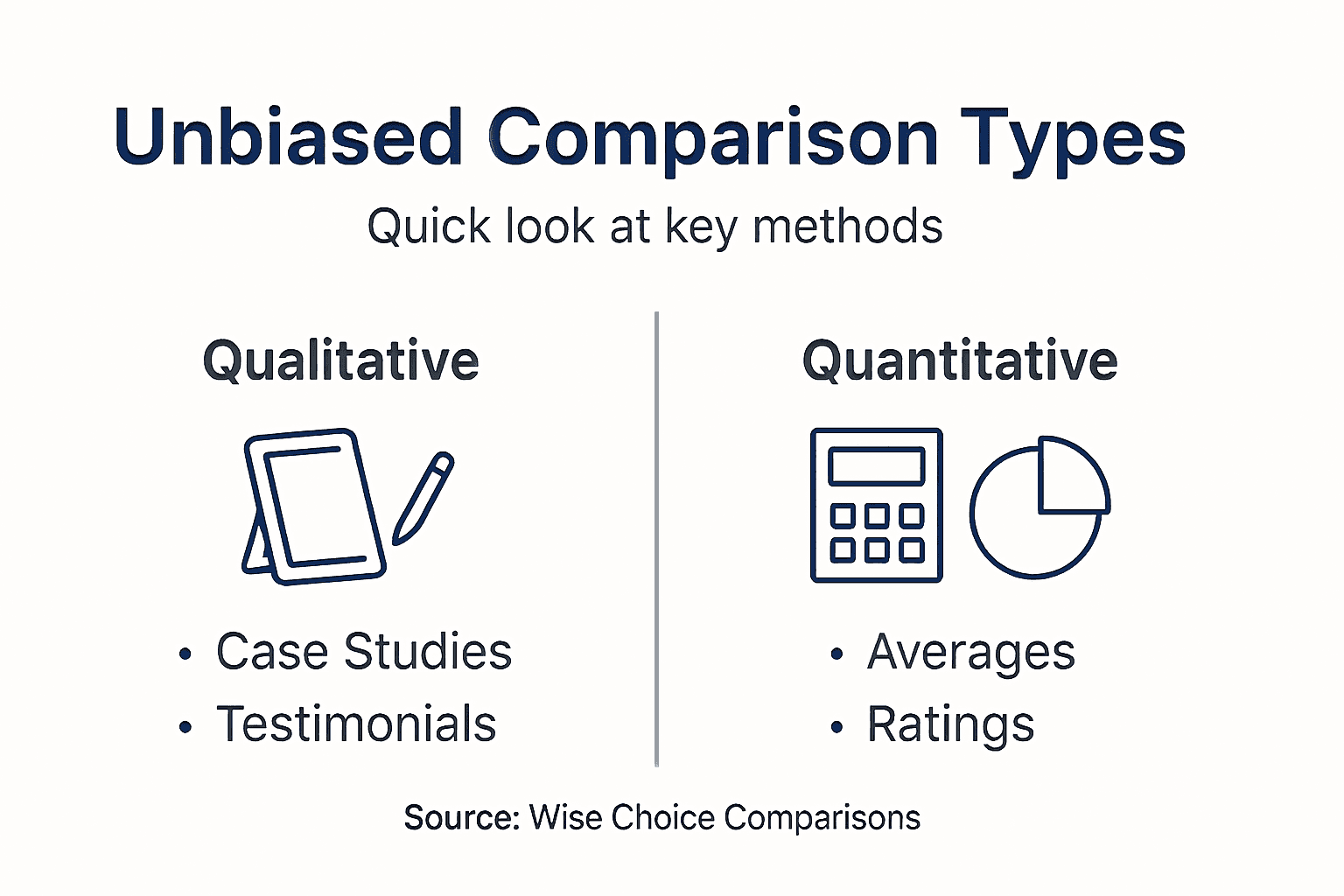
Comparison methods split into two broad categories:
Qualitative methods examine details in depth. Case studies of specific providers, customer testimonials, and detailed policy reviews fall here. You’re understanding the “why” behind choices.
Quantitative methods use numbers and statistics. Comparing average ratings, price ranges across 20 providers, or cost-per-gigabyte for broadband belongs here. You’re seeing patterns at scale.
Both have value. Comparative research methods integrate qualitative and quantitative approaches to reduce individual biases and produce more credible insights.
Mixed-Methods Approach
The strongest comparisons combine qualitative and quantitative data. You might:
- Check numerical ratings and prices across 10 providers (quantitative)
- Read detailed reviews from actual customers (qualitative)
- Compare specific policy clauses side-by-side (quantitative)
- Speak with customer service representatives (qualitative)
This mixed approach catches what each method would miss alone.
The best comparison method aligns with your specific question: are you exploring options or testing which factors matter most?
Pro tip: Choose your comparison method before gathering data. If you decide which approach to use after researching, you’ll naturally favour information that fits your chosen method—a subtle form of bias that undermines objectivity.
Here is a quick reference comparing common unbiased comparison methods:
| Method Type | Suitable Context | Outcome Strength | Typical Effort Required |
|---|---|---|---|
| Descriptive | Quick overviews of options | Highlights differences only | Minimal research needed |
| Analytical | In-depth evaluation of factors | Explains causation, not just contrast | Detailed research and data required |
| Qualitative | Understanding customer experience | Reveals motivations and context | Interviews and subjective analysis |
| Quantitative | Identifying trends across providers | Strong numerical evidence | Data collection and analysis |
| Mixed-Methods | Balancing facts and context | Reduces bias, highly robust | Most effort and time invested |
How Unbiased Comparison Works In Practice
Unbiased comparison isn’t theoretical—it’s a structured process you can follow when evaluating insurance, utilities, broadband, or any household service. The key is using a systematic approach that prevents personal preference from hijacking your decision.
Step-By-Step Practical Process
Start by defining what matters to you before looking at any options. Write down your must-haves and your acceptable trade-offs.
Then apply a consistent evaluation framework across all providers:
- List the same criteria for every option (price, coverage, customer service, contract length)
- Gather data using identical methods (official websites, customer reviews, policy documents)
- Score each option against the same standards
- Document your reasoning—not just the final choice
This structure removes the temptation to shift your criteria mid-comparison to favour a preferred option.
Managing Comparison Risks
Comparative case study approaches manage decontextualisation and ethnocentrism risks by examining options across multiple dimensions simultaneously.
Think of it as viewing your comparison from three angles:
- Horizontal: Compare providers side-by-side (Provider A vs. Provider B vs. Provider C)
- Vertical: Examine different levels within each provider (basic plan vs. premium vs. enhanced coverage)
- Transversal: Consider how conditions change over time (introductory rates vs. renewal prices, service changes)
When comparing broadband, for example, don’t just check current speeds. Ask how the provider performs as contract length increases, what happens at renewal, and how their service compares across different postcodes.
Real-World Application
Imagine comparing car insurance. A single-dimensional view shows only premiums. A structured comparison reveals:
- Premium costs (horizontal comparison)
- What each excess level actually covers (vertical comparison)
- How price changes at renewal versus year one (transversal comparison)
This multi-angle approach prevents you from choosing based on a single misleading factor.
Avoiding Decontextualisation
Context matters enormously. A “cheap” policy might exclude common claims in your situation. A “premium” provider might offer irrelevant add-ons.
Apply your actual circumstances to every evaluation. Don’t compare generic policies—compare the coverage that applies to you.
Structured comparison across multiple dimensions catches biases that single-perspective evaluation always misses.
Pro tip: Create a simple spreadsheet with criteria down the left and providers across the top. Fill in identical data for each provider using the same sources. This visual format makes inconsistencies obvious and prevents you from unconsciously favouring one option with different standards.
Benefits For UK Consumers And Risks Of Bias
Unbiased comparison offers real, tangible benefits to UK households. But bias—whether subtle or systematic—creates genuine risks that can cost you money and limit your choices.
The Real Benefits Of Unbiased Comparison
When you compare options fairly, you gain immediate advantages:
- Better value: You find genuinely cheaper options instead of settling for familiar brands
- Transparent pricing: You see what you’re actually paying without hidden markups
- Equitable access: Fair treatment in comparisons promotes trust and equitable access to products regardless of your background or circumstances
- Informed choices: You understand trade-offs instead of guessing based on assumptions
- Confidence: You know your decision rests on facts, not coincidence
These benefits compound over time. Saving £200 annually on car insurance, £150 on broadband, and £100 on home cover totals £450 yearly—enough for a holiday or emergency fund.
The Hidden Costs Of Bias
Biased comparisons create real harm. You might pay more, receive worse coverage, or miss better options entirely.
Bias can manifest in several ways:
- Algorithmic discrimination: Systems designed to assess risk sometimes penalise groups unfairly
- Hidden pricing: Certain groups face higher costs or denial of services through algorithmic bias in financial products
- Limited information: Bias leads you to ignore options, narrowing your actual choice
- Reinforced inequality: Biased systems can entrench disadvantage across protected characteristics
Consumers with disabilities, older age, or particular postcodes sometimes discover they pay more for identical coverage—not because of genuine risk factors, but because of how data is interpreted.
Below is a summary showing practical impacts of unbiased versus biased comparisons for UK consumers:
| Aspect | Unbiased Comparison Impact | Biased Comparison Risk |
|---|---|---|
| Financial Savings | Maximum value for money found | Higher costs for similar services |
| Decision Confidence | Facts support final choice | Uncertainty and regret likely |
| Fairness | Equal access to best deals | Exclusion and inequality possible |
| Quality of Coverage | Needs matched to products | Poor fit, missed benefits |
Why This Matters To You
You might think bias only affects large-scale data systems. But personal bias—yours and companies’—affects daily household decisions.
When you unconsciously favour one provider because of a good experience years ago, you’re exhibiting bias. When a comparison tool weights customer service reviews from specific areas more heavily, that’s algorithmic bias. Both cost you money.
Unbiased comparison protects your wallet whilst ensuring you receive fair treatment regardless of demographics or past choices.
Your Role In Staying Unbiased
Recognising your own biases is the first step. Compare services using structured methodologies rather than gut feelings or familiar names.
Document why you prefer one option. If the reason isn’t based on data—it’s based on feeling—challenge yourself to look deeper.
Pro tip: Before choosing a provider, ask yourself: “Would I choose this if I’d never heard of them before?” If the answer is no, you’re experiencing brand loyalty bias. Use that as a signal to examine other options more carefully.
Spotting And Avoiding Common Comparison Pitfalls
Even with good intentions, comparison mistakes happen. Recognising these pitfalls before they derail your decision saves time, money, and frustration.
The Rushing Mistake
The biggest pitfall is comparing before you truly understand what you’re looking at. You might scan three insurance quotes and choose based on price alone, missing crucial coverage differences.
Rushing into comparisons without fully understanding items leads to invalid conclusions. Take time to read policy documents, understand exclusions, and know what “standard coverage” actually means for your situation.
When you’re browsing broadband packages, don’t just look at speeds. Understand data caps, contract terms, and whether the advertised speed is guaranteed or typical.
Undefined Criteria Trap
Without clear comparison criteria, you’ll unconsciously shift standards to favour one option. One moment you’re prioritising price, the next customer service.
Define your criteria upfront:
- Must-haves: Non-negotiable requirements (e.g., 24-hour customer support)
- Nice-to-haves: Beneficial but not essential (e.g., loyalty discounts)
- Trade-off limits: Where you’ll compromise (e.g., accepting slightly lower speed for better price)
Document these before researching. This creates a stable measuring stick that prevents criteria-shifting mid-comparison.
The Surface-Level Trap
Stop once you’ve identified differences, and you’ve missed the real insight. That one provider is “cheaper” tells you nothing without understanding why.
Dig deeper:
- Is the lower price temporary (introductory rates that spike at renewal)?
- Are exclusions making the cheap option less valuable?
- Does the provider’s reputation suggest reliability matches the price?
Surface-level comparison feels complete but leaves you vulnerable to poor choices.
Data Quality And Reliability Issues
Not all information is equally trustworthy. Customer reviews on comparison sites vary wildly in reliability. Some reflect genuine experiences; others reflect one person’s frustration.
Be vigilant about:
- Inconsistent definitions: One provider calls something “unlimited” whilst another uses “up to” language
- Missing data: When information isn’t available, don’t assume it’s negligible
- Outdated information: Prices and terms change. Verify dates on quotes
Common Mistakes On Comparison Sites
Comparison platforms themselves can introduce bias. Some highlight common mistakes people make when using comparison sites, like not entering accurate personal data or overlooking filter options.
Always provide truthful information about your circumstances. False data produces meaningless quotes.
Thorough comparison takes longer than impulse decisions, but saves money and prevents regret.
Pro tip: Create a simple table with criteria down the left column and providers across the top. Fill every cell with identical data sources. If a cell is empty, investigate why—missing information often matters more than you think.
Empower Your Decisions With Truly Unbiased Comparison
Choosing the best insurance, utilities, or broadband can feel overwhelming when hidden biases cloud your judgement. This article highlights the importance of unbiased comparison to avoid costly mistakes and ensure fair access to the best deals tailored for you. Wise Choice Comparisons understands these challenges and provides a clear, impartial platform where you can compare regulated providers side-by-side using consistent criteria that matter most.

Take control of your household expenses today by visiting Wise Choice Comparisons. Explore how our platform applies unbiased comparison principles in every quote to help UK consumers find transparent pricing and better value. Start with a quick overview or dive deeper into detailed options by browsing the Uncategorized Archives – Wise Choice Comparisons. Make informed choices with confidence and avoid the risks of bias before your next purchase.
Frequently Asked Questions
What is the importance of unbiased comparison in decision-making?
Unbiased comparison helps individuals evaluate options fairly without personal bias, allowing for informed decisions based on facts rather than assumptions or brand preferences.
How can I avoid bias when comparing insurance or utility services?
To avoid bias, define your comparison criteria before you start, use a consistent evaluation framework across all providers, and document your reasoning for each choice to ensure an objective decision-making process.
What methods can I use for unbiased comparisons?
You can use descriptive comparisons for straightforward overviews, analytical comparisons for exploring relationships, qualitative methods for detailed insights, quantitative methods for statistical analysis, or a mixed-methods approach that combines both qualitative and quantitative data.
What are the risks of making biased comparisons?
Biased comparisons can lead to poor choices, such as paying more for similar services, receiving inadequate coverage, or missing out on better options altogether, ultimately affecting your financial wellbeing and satisfaction with the chosen service.
Recommended
- How to Save Hundreds Every Year Using Comparison Websites in the UK – Wise Choice Comparisons
- How Wise Choice Comparisons Helps You Find Better Deals Faster – Wise Choice Comparisons
- Landing – Wise Choice Comparisons
- 10 Smart Tips for Comparing Insurance Quotes in the UK – Wise Choice Comparisons
- Why Compare Home Loans in New Zealand
- Compare Cost of Living Between Countries 2026 | ShouldIMove