

Searching for ways to lower broadband bills without sacrificing quality feels familiar to many British households. Broadband offers much more than just fast downloads—it shapes how you work, learn, and unwind online. Yet myths about availability and affordability persist, leaving plenty frustrated with slow connections or unexpected costs. This guide explains what actually matters when comparing deals, exposes hidden fees, and helps you pinpoint the best value for your unique situation.
Table of Contents
- Broadband Deals Explained And Common Myths
- Types Of Broadband Deals In The UK
- Key Features: Speed, Reliability, Extras
- Financial Impacts And Hidden Charges Revealed
- Avoiding Pitfalls And Securing The Best Offer
Key Takeaways
| Point | Details |
|---|---|
| Understanding Real Broadband Speeds | Evaluate both download and upload speeds to determine if a broadband deal meets your specific needs. |
| Debunking Common Myths | Be aware that not all broadband deals are the same and understanding the fine print can save money. |
| Evaluating Costs and Hidden Charges | Always consider total costs, including setup fees and equipment rental, rather than just the monthly subscription price. |
| Prioritising Reliability and Support | Investigate customer reviews on provider reliability and support services to ensure a satisfactory experience. |
Broadband deals explained and common myths
Broadband means far more than most people realise. The term describes high-speed internet connections that remain constantly available, transforming how you work, learn, and connect. Unlike older dialup technology, broadband delivers the speed and reliability needed for today’s digital life.
But what exactly counts as broadband? The UK follows standards that define genuine broadband performance, not just marketing claims. Understanding the real specifications helps you spot deals that genuinely improve your service versus promises that sound impressive on paper.
Understanding Real Broadband Speeds
Speed matters more than you might think. Most broadband packages advertise download speeds, but upload speed matters equally for video calls, working from home, or sharing large files. You need both metrics to judge whether a deal actually suits your lifestyle.
Here’s what different speed tiers actually mean for real-world use:
- Basic broadband (10-30 Mbps) works for email, browsing, and standard video streaming on one device
- Standard broadband (30-60 Mbps) handles multiple users and devices simultaneously without buffering
- Superfast broadband (60-150 Mbps) supports heavy streaming, gaming, and working from home with ease
- Ultrafast broadband (150+ Mbps) future-proofs your home for any emerging technology
Your actual speed depends on distance from the exchange, network congestion, and equipment quality—not just the advertised figure.
The gap between advertised speeds and real-world performance frustrates many people. Providers list maximum potential speeds, but interference, distance, and network load reduce actual performance. When comparing deals, look for minimum guaranteed speeds rather than peak figures.
Debunking Common Broadband Myths
Misunderstandings cost you money and lead to poor contract choices. Let’s clear up what people commonly get wrong.
Myth 1: All broadband deals are essentially the same
This couldn’t be further from the truth. Contract length, speed consistency, customer service, and price variation create massive differences between providers. One deal might offer faster speeds for less money whilst another charges premium rates for older infrastructure. Only detailed comparison reveals the real value.

Myth 2: You can’t do anything about poor broadband
You absolutely can. Switching providers, negotiating with your current supplier, upgrading your package, or using comparison tools to find better deals all work. Many people simply accept whatever they’re paying without exploring alternatives. Taking 20 minutes to compare options often saves hundreds annually.
Myth 3: Higher speeds always mean better value
Not necessarily. If you only browse and use email, paying extra for superfast speeds wastes money. Conversely, basic speeds cause frustration if you stream 4K video or game regularly. Value means matching speed to your actual needs, not buying the fastest available option.
Myth 4: Broadband availability and affordability are universal
Disparities in broadband access persist across different regions and income levels. Rural areas often face limited provider options and higher costs. Understanding your local availability helps set realistic expectations about what deals you can actually access.
What Actually Matters When Comparing Deals
Focus on factors that directly impact your experience and wallet:
- Check contract length and early exit fees carefully
- Confirm minimum guaranteed speeds in writing, not just advertised maximums
- Compare total monthly cost including setup fees and equipment rental
- Review customer service ratings and reliability records
- Look for price lock periods so rates don’t jump after year one
- Verify whether installation costs apply to your address
- Check whether the provider caps data usage or offers unlimited access
Many people overlook contract terms because they focus solely on monthly price. A cheaper deal becomes expensive if early termination costs £150 or your speeds drop dramatically during peak hours. Reading the full terms matters as much as the headline figure.
Pro tip: Use comparison websites when your contract renewal date approaches, not just when you’re frustrated—this gives you maximum negotiating power with your current provider, who often match better offers to keep your business.
Types of broadband deals in the UK
Broadband deals in the UK vary dramatically depending on where you live and what technology reaches your address. Not every household can access the same options, which is why understanding what’s available to you matters before comparing prices. Different technologies deliver different speeds and reliability, so knowing your options helps you make informed choices.
The UK broadband market offers several distinct types of deals, each suited to different situations and needs. Your postcode determines which technologies are available, so checking your specific address should always be your first step.
Technology Types Available
Different broadband technologies perform at different speeds and price points. Understanding what each type offers helps you evaluate whether a deal is genuinely better for you.
Fibre optic broadband delivers the fastest speeds and most reliable connections. Fibre cables carry data as light signals, enabling speeds of 60 Mbps to over 1 Gbps depending on the specific package. This technology suits homes with multiple users, heavy streaming, gaming, or working from home. Fibre costs more than older technologies but offers superior performance and future-proofing.
Cable broadband uses the same infrastructure as television signals, delivering decent speeds typically between 50-200 Mbps. Cable performs reliably in urban areas where multiple customers share the same network segment. This technology works well for most households but can slow during peak usage times when many neighbours use the service simultaneously.
DSL broadband remains the most widely available technology, using traditional copper telephone lines to deliver internet. Speeds typically range from 2-17 Mbps depending on your distance from the telephone exchange. DSL broadband costs less than fibre but offers slower speeds, making it suitable only for basic tasks like email and light browsing.
Fixed wireless broadband transmits internet via radio signals from ground-based towers rather than physical cables. This technology reaches rural and remote areas where laying cables isn’t economically feasible. Speeds range from 10-50 Mbps, with performance affected by weather and obstacles between your property and the transmitter.
To help you evaluate broadband technologies, here’s a side-by-side comparison of their typical performance and suitability:
| Technology Type | Typical Speed Range | Reliability | Ideal For |
|---|---|---|---|
| Fibre Optic | 60 Mbps–1 Gbps+ | Highly reliable | Families, home workers |
| Cable | 50–200 Mbps | Reliable | Urban households |
| DSL | 2–17 Mbps | Less reliable | Basic browsing, email |
| Fixed Wireless | 10–50 Mbps | Weather affected | Rural, remote locations |
Broadband technology available at your address depends entirely on local infrastructure, so checking your postcode reveals your actual options.
Deal Types for Different Circumstances
Beyond technology, broadband deals come in different structures suited to different budgets and situations.
Standard commercial deals form the bulk of the market. Providers offer various speed packages at different monthly rates, typically with 12 or 24 month contracts. These deals target general consumers and offer the widest selection of speeds, prices, and contract lengths. Monthly costs range from roughly £20 to £60 depending on speed and provider.
Social tariffs provide affordable broadband specifically for low-income households. Social tariffs offer unlimited broadband typically over 30 Mbps at significantly reduced rates—sometimes as low as £10 monthly—for people receiving Universal Credit, Pension Credit, or other qualifying benefits. These deals often include flexible terms and minimal setup costs, making broadband genuinely accessible to those on tight budgets.
Bundle deals combine broadband with mobile, TV, or landline services at discounted rates. Bundling often saves money compared to purchasing each service separately, though you’re locked into multiple contracts. This approach suits households wanting a single provider for simplicity.
Pay-as-you-go broadband remains rare but exists for short-term needs. Rather than monthly contracts, you pay per gigabyte of data used. This option suits temporary situations or people with extremely light usage, though it typically costs more per unit than contracted deals.
Comparing What’s Actually Available to You
Your address determines which deals you can genuinely access. Postcode checkers reveal real options rather than theoretical ones. Once you know your available technologies and speeds, comparing prices becomes straightforward. Don’t assume you’re limited to your current provider—most areas have multiple options worth investigating.
Pro tip: Check your address on multiple comparison websites rather than just one, as some providers partner with specific comparison sites, ensuring you see every available deal before making your choice.
Key features: speed, reliability, extras
When comparing broadband deals, three features dominate the decision: speed, reliability, and extras. These three factors determine whether a deal genuinely improves your internet experience or simply costs less whilst delivering frustration. Understanding what each feature means helps you evaluate whether a particular offer suits your actual needs.
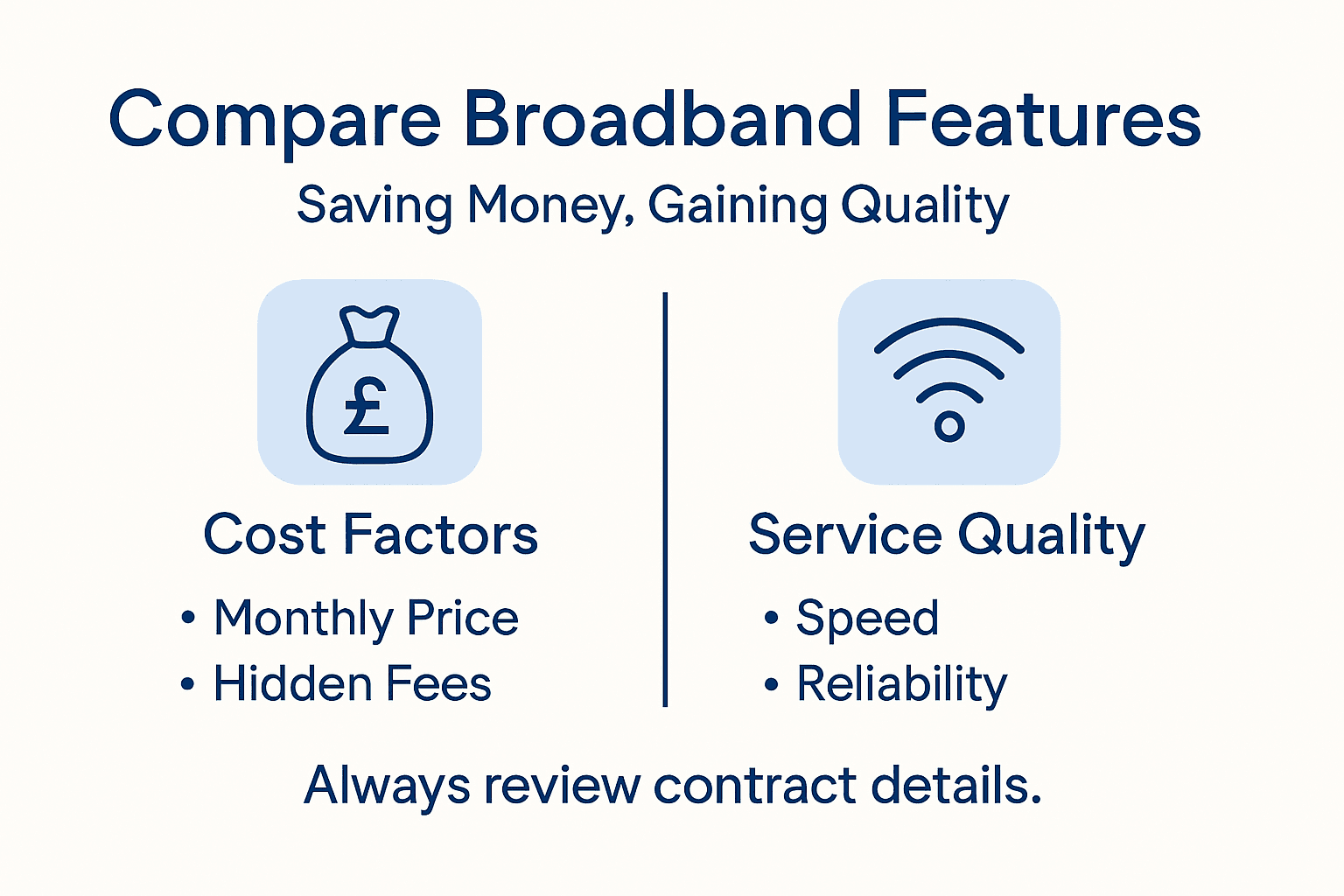
Speed grabs headlines, but reliability keeps you connected when it matters most. Extras can sweeten a deal significantly, though they’re often overlooked during initial comparisons. Balancing all three reveals which broadband package truly offers best value for your household.
Speed: More Than Just the Number
Speed determines what you can realistically do online. Download speed affects streaming quality, file transfers, and browsing smoothness. Upload speed matters for video calls, working from home, and sharing large files. Most people focus only on download speeds, missing half the picture.
Here’s what different speeds enable in practice:
- 10-20 Mbps handles email, web browsing, and standard video streaming on one device
- 30-50 Mbps supports multiple devices and 4K video streaming simultaneously
- 50-100 Mbps enables smooth online gaming, video conferencing, and large file uploads
- 100+ Mbps future-proofs your home for emerging technologies and heavy usage patterns
The speed you need depends entirely on your household. A pensioner living alone needs far less than a family with three teenagers streaming video whilst someone works from home. Overpaying for speeds you’ll never use wastes money; underbidding creates frustration.
Speed enables critical activities like remote work, streaming education, and staying connected—matching speed to your needs prevents wasted spending.
Reliability: The Often-Ignored Feature
Reliability means your connection stays live when you need it. A faster connection that drops regularly frustrates far more than a slightly slower connection that never fails. Reliability encompasses uptime percentage, outage frequency, and how quickly providers fix problems.
Check reliability through customer reviews rather than provider claims. Real people report actual experiences—disconnections during storms, regular evening slowdowns, or consistent problems during peak hours. These patterns reveal whether a provider’s infrastructure genuinely supports its promises.
Some providers offer compensation for outages exceeding specific durations. Others provide minimal customer support when problems occur. Reading the fine print about service guarantees separates reliable providers from those cutting corners on network investment.
Extras: The Deal Sweeteners
Extras transform mediocre deals into excellent ones. Common additions include:
- Free installation saves £50-150 compared to standard fees
- Router included avoids expensive equipment purchases
- Technical support makes troubleshooting far less painful
- Device discounts help when upgrading laptops or tablets
- Bundle discounts reduce total monthly costs across multiple services
- Loyalty bonuses reward staying with the same provider
Extras matter most when they address your actual situation. Free installation saves money only if you’d pay for it otherwise. Device discounts help budget-conscious households but mean nothing if you’re not buying equipment.
Some providers offer digital support programmes for underserved communities, providing training alongside broadband. These extras expand beyond cost savings into genuine social value, though they’re rarely advertised widely.
Evaluating All Three Together
The best broadband deal balances speed matching your needs, reliability ensuring consistent service, and extras adding genuine value. A £15 monthly saving means nothing if constant outages disrupt your work. Premium speed serves no purpose if you only browse and email. Comprehensive evaluation prevents regrettable choices.
Pro tip: When comparing deals, weight reliability reviews as heavily as price—paying slightly more for a provider with consistently strong uptime ratings prevents far costlier disruptions to your work, education, or family time.
Financial impacts and hidden charges revealed
The true cost of broadband rarely matches the headline price advertised online. Hidden charges, setup fees, equipment costs, and price increases after initial contract periods catch many people off guard. Understanding where extra charges hide reveals the real monthly cost you’ll actually pay.
Broadband pricing exists on multiple levels. The advertised monthly fee represents only the base subscription—everything else is added on top. Transparent pricing requires providers to disclose all mandatory costs upfront, yet many disguise additional charges within contract terms most people never read.
Common Hidden Charges
Setup and installation fees represent the first surprise. Providers often advertise competitive monthly rates whilst burying £50-150 setup costs in fine print. Some charge extra for engineer visits, even when installation should be included. Professional installation costs vary wildly between providers—comparing total first-year costs reveals vastly different true pricing.
Equipment rental or purchase adds ongoing expenses. Monthly router rental fees of £5-10 compound over 24 months into £120-240 extra spending. Some providers force equipment purchases upfront rather than offering rentals, shifting costs entirely onto you. Owned equipment gives you flexibility to upgrade independently, whilst rental locks you into provider control.
Price increases after year one represent the most frustrating hidden charge. Initial contracts offer promotional rates for 12 or 24 months, then jump substantially—sometimes by 30-40%—when the promotion ends. The advertised deal becomes significantly more expensive unless you switch providers when renewal approaches.
Here’s where hidden costs typically hide:
Here’s a summary of key hidden charges to check before choosing a broadband deal:
| Fee Type | Typical Cost | When Applied | How to Avoid |
|---|---|---|---|
| Installation/Setup | £50–£150 | New connections | Request fee waiver |
| Router Rental | £5–£10 monthly | Throughout contract | Buy your own device |
| Early Termination | £100–£300 | Ending contract early | Select flexible contracts |
| Price Hike After Year 1 | 30–40% increase | Renewal/contract ends | Switch or renegotiate offer |
- Installation and engineer visit fees (£50-150)
- Monthly equipment rental (£5-10 per month)
- Activation or connection fees (£10-25)
- Early termination charges if you leave before contract ends (£100-300)
- Price increases at contract renewal (often 30-40% rises)
- Data overage charges if your package includes caps
- Admin fees for billing address changes or payment method updates
Transparent pricing practices require all mandatory costs to be disclosed upfront—use this standard to evaluate whether providers truly show you complete pricing.
Economic Pressures Affecting Broadband Costs
Broadband infrastructure carries significant expenses. Laying cable, maintaining networks, and upgrading technology require substantial capital investment. Rising costs from inflation and interest rates increase deployment expenses, which providers eventually pass to consumers through higher fees.
Rural areas face particular financial pressure. Fewer customers spread infrastructure costs across wider areas, making rural broadband inherently more expensive to provide. This reality explains why rural broadband deals cost more and offer fewer choices than urban equivalents.
Understanding these economic factors doesn’t excuse hidden charges, but it explains why broadband isn’t cheap. Transparent pricing acknowledges actual costs rather than disguising them.
Spotting Real Costs Before Signing
Always calculate total first-year and second-year costs, not just monthly rates. Request written quotes including every fee—setup, equipment, installation, and contract terms. Compare these complete costs across providers rather than headline monthly prices alone.
Read contract terms thoroughly, especially sections covering price changes, early termination, and equipment ownership. Contact customer service with specific questions about any charges listed but unexplained. Legitimate providers answer clearly; those being deliberately obscure signal future problems.
Pro tip: Request removal of setup fees when signing up—many providers waive these charges for new customers who ask directly, though they’ll never volunteer this saving without negotiation.
Avoiding pitfalls and securing the best offer
Securing the best broadband offer requires more than scanning prices and speed figures. Many people rush into deals without understanding actual coverage, reliability, or long-term costs—only to regret their choice months later. Strategic comparison prevents costly mistakes and ensures you select a provider matching your genuine needs.
The best offer isn’t always the cheapest one advertised. Low upfront costs hide expensive long-term commitments. Unreliable providers frustrate far more than they save money. Understanding what separates genuine value from marketing hype transforms how you approach broadband selection.
Understand Your Actual Connectivity Needs
Start by honestly assessing what you actually need. If you’re a rural household, fibre might not reach you—accepting DSL or fixed wireless prevents disappointment. Urban dwellers with multiple devices need higher speeds than pensioners living alone. Matching package specifications to real-world usage prevents overpaying for unnecessary speed or underpaying and suffering poor performance.
Test your current connection during peak hours. Experience real speeds rather than theoretical maximums. This baseline reveals what improvements genuinely matter. Someone struggling with video buffering during evenings might need speed increases; someone gaming or streaming 4K definitely does.
Beyond Price: Reliability and Support Matter
Provider reliability determines whether your deal delivers actual value. Customer experience and service consistency matter as much as speed. A £5 monthly saving disappears when outages disrupt work or education. Research customer reviews specifically mentioning outages, support responsiveness, and speed consistency during peak hours.
Check what providers offer regarding support channels. Do they provide phone support at reasonable hours? Email support with quick response times? Live chat options? Good providers invest in customer service; poor ones bury support contact information and maintain slow response times.
Infrastructure investment reveals provider commitment. Providers investing in modern fibre networks typically maintain better reliability and lower latency than those using ageing copper infrastructure. This matters long-term more than initial monthly savings.
Avoiding Common Pitfalls
These mistakes derail broadband deal satisfaction:
- Signing without reading terms leads to shock at contract costs, price increases, and early termination fees
- Ignoring contract length ties you to poor providers for years if you can’t switch
- Overlooking coverage checks results in selecting unavailable services or inadequate speeds for your location
- Focusing solely on headline speed ignores reliability, upload speeds, and actual performance
- Accepting first offers without negotiation means missing available discounts and fee waivers
- Underestimating data needs causes frustration with capped packages or unexpected overage charges
Infrastructure complexity and deployment challenges mean some areas genuinely have limited options—understanding local constraints prevents frustration with unavailable services.
Securing the Best Offer: Practical Steps
- List all available providers at your postcode using comparison tools
- Check each provider’s reliability ratings and customer reviews
- Request complete pricing quotes including all fees and contract terms
- Compare total first-year and second-year costs, not just monthly rates
- Verify coverage and actual speeds you’ll receive (not just advertised maximums)
- Negotiate—ask about removing setup fees or matching competitor offers
- Read contract terms thoroughly before committing
- Document promises made during sales conversations
Timing matters significantly. Comparing near your contract renewal date gives maximum negotiating power with current providers. Many waive fees or reduce rates for loyal customers facing attractive competitor offers.
Pro tip: Contact your current provider with a better competing offer and ask them to match it before switching—many do, saving switching hassles whilst securing improved rates.
Make Wise Choices to Save on Broadband Costs and Boost Quality
Navigating broadband deals can be overwhelming with hidden fees, unclear speed claims, and confusing contract terms affecting your wallet and internet experience. Wise Choice Comparisons understands these challenges by focusing on clear comparisons that highlight real speeds, total costs, and reliable providers. Avoid costly pitfalls like unexpected setup charges and misleading price hikes by using a platform designed specifically for UK consumers to make informed, confident decisions.

Discover how you can unlock the best broadband package tailored to your unique needs today. Visit Wise Choice Comparisons for unbiased quotes and detailed information. Start comparing your options now and take control of your household expenses with transparent, user-friendly tools that empower you to save money while gaining better broadband quality. Don’t wait until your contract ends – act now to secure your savings and internet reliability.
Frequently Asked Questions
What are the benefits of comparing broadband deals?
Comparing broadband deals can help you save money, find a plan that suits your specific needs, and gain access to better speeds and reliability. It allows you to spot the best offers based on your usage patterns and budget.
How do I know which broadband speed I need?
To determine the speed you need, consider your household’s online activities. For activities like browsing and email, 10-30 Mbps may suffice. For streaming, gaming, or working from home, aim for at least 60 Mbps.
What should I look for when comparing broadband deals?
When comparing broadband deals, focus on contract length, minimum guaranteed speeds, total monthly costs (including any fees), customer service ratings, and any extra features or incentives included in the deal.
Are there hidden charges I should be aware of?
Yes, many broadband packages may have hidden charges such as installation fees, equipment rental costs, and price increases after the initial contract period. Always check the fine print for any additional costs before signing up.
Recommended
- How to Save Hundreds Every Year Using Comparison Websites in the UK – Wise Choice Comparisons
- How to Save Hundreds Every Year Using Comparison Websites in the UK – Wise Choice Comparisons
- Services – Wise Choice Comparisons
- Top 10 UK Services You Should Compare Before Renewing in 2026 – Wise Choice Comparisons
- “You Don’t Know What You Don’t Know” – Mortgage Managers
- How to Compare Life Insurance Policies for the Best Value
- Numbeo Alternatives: 7 Best Cost of Living Comparison Tools in 2026 | ShouldIMove