

Facing rising costs on everything from utilities to insurance makes it harder for British households to stretch their budgets. With so many providers and confusing offers, finding honest comparisons can feel like searching for a needle in a haystack. Independent comparison platforms offer a practical way to cut through marketing noise and bring clarity to crucial spending choices, helping you spot real value and avoid costly mistakes.
Table of Contents
- Defining Independent Comparison and Its Role
- Types of Comparison Platforms and Processes
- How Independence Guarantees Transparency and Trust
- Legal Compliance and Consumer Protection in Comparisons
- Practical Impacts on Household Expenditure
- Common Pitfalls and Misleading Alternatives to Avoid
Key Takeaways
| Point | Details |
|---|---|
| Importance of Independent Comparison | Independent comparison platforms provide unbiased insights, helping consumers make informed decisions about essential household expenses. |
| Role of Independent Reviewers | Appointed for their expertise, independent reviewers ensure objective assessments free from commercial influences. |
| Consumer Empowerment | These platforms enable consumers to navigate complex markets, ultimately leading to potential savings and better financial decisions. |
| Avoiding Misleading Information | Consumers should be cautious of platforms with hidden fees or outdated data; cross-referencing multiple sources is crucial for accurate comparisons. |
Defining Independent Comparison and Its Role
In the complex landscape of consumer services, independent comparison has emerged as a critical tool for British consumers seeking transparent, unbiased insights into essential household expenses. Unlike traditional marketing channels, independent comparison platforms provide an objective lens through which individuals can evaluate multiple service options without inherent commercial bias.
At its core, independent comparison represents a systematic approach to assessing various products and services by maintaining strict review protocols. These platforms operate with a fundamental commitment to objectivity, ensuring that recommendations are driven by rigorous analysis rather than commercial incentives. The key characteristics of truly independent comparison include:
- Complete transparency about comparison methodologies
- No financial relationships that could compromise recommendations
- Comprehensive evaluation across multiple service providers
- Clear presentation of both advantages and limitations of each option
- Consistent, standardised assessment criteria
Independent reviewers play a pivotal role in this ecosystem. They are appointed specifically for their expertise and tasked with delivering objective assessments based on predefined, impartial criteria. This approach ensures that consumers receive credible, trustworthy information that empowers them to make informed decisions about their household services.
The significance of independent comparison extends beyond mere price comparisons. It represents a consumer empowerment mechanism that breaks through marketing noise, providing clear, factual insights that help individuals navigate complex service landscapes. By presenting comprehensive, unbiased information, these platforms transform how UK consumers approach critical purchasing decisions.
To better understand the unique value of independence in comparison platforms, see how independent and commercial platforms differ:
| Aspect | Independent Platform | Commercial Platform |
|---|---|---|
| Review Methodology | Transparent and disclosed | Often undisclosed |
| Revenue Sources | No commissions from providers | Relies on referral fees |
| Objectivity Level | High, impartial analysis | Influenced by partnerships |
| Consumer Trust | Generally higher | Can be lower due to conflicts |
| Data Accuracy | Regularly audited | Sometimes outdated |
Pro tip: Always verify the independence of your comparison platform by checking their disclosure statements and understanding their revenue model.
Types of Comparison Platforms and Processes
The landscape of digital comparison tools in the United Kingdom has evolved dramatically, offering consumers sophisticated mechanisms to evaluate and compare various services and products. Digital comparison platforms represent a diverse ecosystem of technological solutions designed to simplify complex purchasing decisions across multiple sectors.
These comparison platforms can be categorised into several distinct types, each serving unique consumer needs:
- Price Comparison Websites: Aggregate pricing information across multiple providers
- Best Buy Tables: Rank products or services based on predefined criteria
- Matching Services: Connect consumers directly with appropriate service providers
- Voice-Based Comparison Tools: Leverage emerging voice technology for easier comparisons
- Reverse Auction Platforms: Allow consumers to solicit competitive bids from service providers
Consumer research on digital comparison tools reveals fascinating insights into how these platforms operate. They typically employ multiple data collection strategies, including direct supplier feeds, third-party data aggregation, and sophisticated web scraping techniques to compile comprehensive service information.
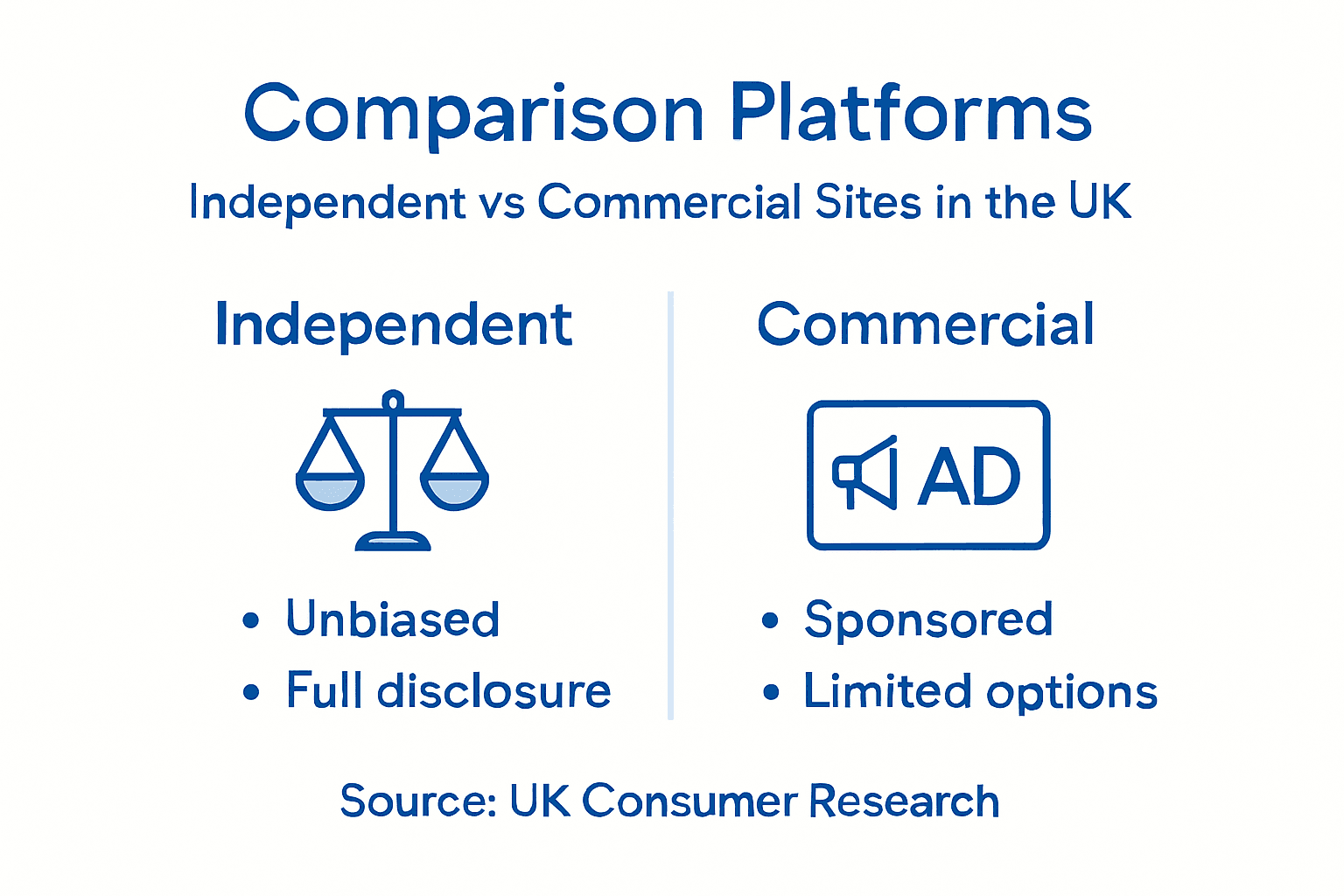
The revenue models for these platforms are equally diverse, ranging from cost-per-acquisition fees to cost-per-click arrangements. This variety ensures that comparison platforms can maintain operational sustainability while providing valuable consumer insights across sectors such as insurance, travel, utilities, and financial services.
Pro tip: Always compare multiple comparison platforms to ensure you’re getting the most comprehensive and up-to-date service information.
How Independence Guarantees Transparency and Trust
In the intricate world of consumer services, independence stands as the critical cornerstone of trust and transparency. Trust in institutions fundamentally depends on the ability to provide unbiased, comprehensive information that empowers consumers to make informed decisions without hidden agendas or commercial manipulation.
The key mechanisms that ensure independence and transparency include:
- Complete disclosure of comparison methodologies
- Absence of financial incentives from service providers
- Clear presentation of data sources
- Robust conflict of interest policies
- Regular independent audits of comparison processes
- Transparent revenue models
- Consistent and standardised evaluation criteria
Transparency in governance and comparisons represents a vital principle that builds public confidence. Independent comparison platforms achieve this by implementing rigorous processes that eliminate potential bias and create a level playing field for consumers seeking honest, reliable information about various services.

The psychological impact of independence cannot be overstated. When consumers perceive that information is presented honestly and comprehensively, their trust in the platform increases dramatically. This trust translates into higher engagement, more confident decision-making, and a sense of empowerment that goes beyond mere price comparisons.
Pro tip: Always verify a comparison platform’s independence by reviewing their methodology statements and understanding their revenue sources.
Legal Compliance and Consumer Protection in Comparisons
The rapidly evolving digital marketplace demands robust consumer protection frameworks that safeguard individuals’ interests in online service comparisons. Recent legislative developments have significantly strengthened the legal landscape, providing consumers with enhanced protection against misleading practices and unfair trading strategies.
Key legal protections for consumers in comparison platforms include:
- Clear disclosure of comparison methodologies
- Transparent pricing information
- Protection against misleading advertising
- Mechanisms for dispute resolution
- Mandatory accuracy in service representations
- Protection of personal data
- Right to comprehensive and unbiased information
UK consumer protection law specifically addresses online platforms, ensuring that comparison sites operate with rigorous standards of transparency and fairness. The Consumer Rights Act 2015 provides a comprehensive framework that defines consumer rights, mandates clear information provision, and establishes remedies for potential misconduct.
The Digital Markets, Competition and Consumers Act 2024 represents a significant milestone, empowering regulatory bodies like the Competition and Markets Authority (CMA) to take direct enforcement actions against platforms that fail to meet stringent consumer protection standards. This legislative approach ensures that comparison platforms are held accountable for maintaining high levels of integrity and transparency in their operations.
Pro tip: Always review the terms of service and check a platform’s regulatory compliance before using their comparison services.
Practical Impacts on Household Expenditure
In the current economic landscape, independent comparison platforms have become critical tools for British households seeking to optimise their financial resources. Household spending trends reveal that consumers are increasingly strategic about discretionary expenditure, with approximately 20% of income allocated to non-essential goods and services.
Key areas where independent comparison directly influences household budgeting include:
- Reducing insurance premium costs
- Identifying more competitive utility rates
- Minimising broadband and mobile contract expenses
- Discovering better banking and financial product options
- Optimising travel and leisure service selections
- Managing energy consumption expenses
- Streamlining telecommunications spending
UK government distributional analyses demonstrate how transparent product comparisons can substantially impact household income allocation. By providing comprehensive, unbiased information, comparison platforms enable consumers to make more informed decisions that potentially save hundreds of pounds annually.
The cumulative effect of these savings extends beyond immediate financial relief. Strategic comparisons help households build financial resilience, allowing them to redirect funds towards savings, investments, or quality-of-life improvements during periods of economic uncertainty.
For clarity on how digital comparison platforms impact everyday household budgets, consider their benefits across major spending categories:
| Expense Category | Typical Savings with Comparison | Common Platform Used |
|---|---|---|
| Utilities | Up to £250 per year | Price comparison websites |
| Insurance | £100+ annually | Best buy tables |
| Broadband/Mobile | £50-£120 per year | Matching services |
| Banking Products | Increased interest earned | Reverse auctions |
| Travel/Leisure | Lower rates, more choice | Voice-based tools |
Pro tip: Review your household expenses quarterly using independent comparison platforms to continuously optimise your spending strategy.
Common Pitfalls and Misleading Alternatives to Avoid
Navigating the complex landscape of comparison platforms requires consumers to be vigilant against potential misleading information strategies. Statistical misrepresentation can create significant challenges for consumers seeking genuine, unbiased comparisons of services and products.
Common pitfalls that consumers should be aware of include:
- Platforms with hidden commission structures
- Comparison sites that only show partial pricing information
- Websites displaying outdated or inaccurate service details
- Comparisons that exclude key service features
- Platforms with restricted provider listings
- Misleading graphical representations of data
- Sites with complex, obfuscated pricing models
Competition and market restrictions can significantly undermine the integrity of comparison platforms. For instance, the Competition and Markets Authority has previously fined comparison websites for implementing clauses that limit genuine market competition, demonstrating the complex regulatory challenges in maintaining transparent comparison services.
Consumers must develop a critical approach to using comparison platforms, understanding that not all seemingly objective comparisons are truly independent. Recognising the potential for bias, cherry-picked data, and intentional omissions is crucial in making informed financial decisions that genuinely serve individual household needs.
Pro tip: Always cross-reference information from multiple independent comparison platforms to verify the accuracy of service details and pricing.
Empower Your Household Budget with Truly Independent Comparison
The article highlights the critical need for transparent and unbiased evaluation when it comes to essential UK household services. Consumers face challenges such as hidden commissions, misleading information, and complex pricing models that can make finding the best deals a frustrating experience. At the heart of this struggle is the quest for independence and trustworthiness in comparison platforms — exactly what Wise Choice Comparisons delivers. Our platform offers free, impartial comparisons across key spending areas like insurance, utilities, broadband, and banking, helping you avoid common pitfalls by presenting clear, fully transparent information you can rely on.
Take control of your household expenses today by visiting Wise Choice Comparisons. Start optimising your spending with confidence through our user-friendly portal that reflects the principles of independence, transparency, and consumer protection emphasised throughout the article. Explore a world where your savings and financial resilience come first at Uncategorized – Wise Choice Comparisons. Don’t wait — empower yourself now with trustworthy insights and begin saving smarter on the services that matter most.
Frequently Asked Questions
What is independent comparison?
Independent comparison refers to a transparent, unbiased method of evaluating products and services, ensuring recommendations are based on rigorous analysis rather than commercial incentives.
How do independent comparison platforms ensure transparency?
They ensure transparency by disclosing their methodologies, avoiding financial relationships with service providers, conducting regular audits, and presenting clear information free from hidden agendas.
What types of services can I compare using independent comparison platforms?
You can compare a wide range of services including insurance, utilities, broadband, banking products, and travel options, enabling you to make informed decisions and save money.
What common pitfalls should I avoid when using comparison platforms?
Avoid platforms with hidden commission structures, outdated service details, or those that only show partial pricing information. Always cross-reference multiple sources to ensure the accuracy of comparisons.