

Sorting through insurance documents can leave even the most organised British households feeling lost. Technical language and policy jargon often make simple decisions a challenge when comparing costs for home, health, or car cover. By breaking down insurance terms into plain English, you gain the confidence to spot real value and avoid costly mistakes. This guide puts practical definitions at your fingertips, helping you make smarter choices for yourself and your family.
Table of Contents
- Insurance Jargon: What It Really Means
- Decoding Key Terms and Policy Features
- Types of Insurance and Variations Explained
- Where Jargon Trips People Up Most
- How to Cut Through Jargon When Comparing
Key Takeaways
| Point | Details |
|---|---|
| Understand Key Terms | Familiarise yourself with essential insurance terminology such as premium, deductible, and claim to make informed choices. |
| Decode Policy Features | Pay attention to critical components like declarations page and coverage limits to grasp your policy’s scope. |
| Recognise Insurance Types | Differentiate between types of insurance, such as life, health, and auto, to ensure adequate coverage for your needs. |
| Clarify Jargon | Always seek explanations for confusing terms to avoid misunderstandings that could impact your financial security. |
Insurance Jargon: What It Really Means
Navigating the world of insurance can feel like deciphering a complex code. From policy documents filled with technical terms to conversations with insurance agents, the language can seem intentionally confusing. Fortunately, understanding insurance terminology doesn’t require a law degree or years of industry experience.
The insurance industry is notorious for its specialised vocabulary, which can leave many consumers feeling overwhelmed. Comprehensive insurance term resources provide clarity, helping demystify the language that often creates unnecessary anxiety around insurance decisions.
Key insurance terms you should know include:
- Premium: The amount you pay for your insurance policy, typically monthly or annually
- Deductible: The amount you must pay out-of-pocket before insurance coverage begins
- Claim: A formal request to your insurance company for compensation after an insured event
- Underwriting: The process insurers use to assess risk and determine policy pricing
- Exclusion: Specific situations or conditions not covered by your insurance policy
Understanding these fundamental terms can significantly improve your ability to compare policies and make informed choices. Each term represents a critical aspect of how insurance contracts function, providing transparency about what you’re purchasing and what protection you’ll receive.
Insurance language isn’t designed to confuse you—it’s a precise way of communicating complex financial protection mechanisms. By breaking down these essential insurance terms, consumers can become more confident in their insurance decisions.
Learning insurance terminology transforms you from a confused consumer into an empowered decision-maker.
Pro tip: Always ask your insurance provider to explain any terms you don’t understand, and request they clarify technical language in simple, straightforward language.
Decoding Key Terms and Policy Features
Understanding the intricate details of insurance policies can feel like navigating a complex maze. Each document is packed with technical language that can overwhelm even the most diligent consumer. Yet, knowing how to decode these terms is crucial for making informed insurance decisions that protect your financial well-being.

Insurance policy terminology encompasses a range of critical components that define your coverage, rights, and obligations. These aren’t just random words—they’re precise legal definitions that determine exactly what protection you’ll receive.
Key policy features you must understand include:
- Declarations Page: The summary of your specific policy details, including coverage limits and personal information
- Coverage Limits: The maximum amount an insurer will pay for a specific type of claim
- Endorsements: Modifications to your original policy that add, delete, or change coverage
- Conditions: Specific requirements you must meet for the policy to remain valid
- Riders: Additional provisions that expand or limit your base policy’s coverage
The complexity of insurance documents isn’t designed to confuse you, but to provide absolute clarity about the financial protection you’re purchasing. Essential policy components help both insurers and policyholders understand their exact responsibilities and expectations.
Understanding your policy’s fine print transforms you from a passive policyholder into an informed consumer.
Most insurance policies follow a standard structure, but the specific details can vary significantly between providers and types of coverage. Reading and comprehending these documents gives you the power to choose the right protection for your unique circumstances.
Pro tip: Request a detailed walkthrough of your policy’s key terms with your insurance agent, and don’t hesitate to ask for explanations of any language you find unclear.
Types of Insurance and Variations Explained
Insurance is not a one-size-fits-all solution. Different life stages, personal circumstances, and risk profiles demand specific types of protection. Understanding the nuanced landscape of insurance categories can help you build a comprehensive safety net tailored to your unique needs.
The primary insurance types can be broadly categorised into several key domains:
- Life Insurance: Provides financial protection for your dependents in case of your unexpected death
- Health Insurance: Covers medical expenses, treatments, and potential hospitalisation costs
- Auto Insurance: Protects against financial losses from vehicle-related accidents and damages
- Home Insurance: Safeguards your property and possessions against theft, damage, and natural disasters
- Liability Insurance: Offers protection against potential legal claims and financial damages
Each insurance type comes with multiple variations designed to address specific scenarios. For instance, motor insurance encompasses comprehensive and third-party variations, each offering different levels of protection and financial coverage.
Not all insurance policies are created equal—understanding the nuances can save you thousands of pounds.
Beyond standard categories, specialised insurance products continue to emerge, catering to increasingly specific risk profiles. Travel insurance, professional indemnity cover, and personal accident policies demonstrate the insurance industry’s capacity to create targeted protection mechanisms.
To help clarify the practical distinctions between major insurance types, see the summary below:
| Insurance Type | Typical Coverage Focus | Who Should Consider It | Common Policy Variation |
|---|---|---|---|
| Life Insurance | Family financial protection | Parents, breadwinners | Term vs Whole Life |
| Health Insurance | Medical expenses and treatments | All adults and families | Private vs NHS |
| Auto Insurance | Vehicle accidents and damages | Vehicle owners and drivers | Comprehensive vs Third-Party |
| Home Insurance | Property and personal possessions | Homeowners and tenants | Buildings vs Contents |
| Liability Insurance | Legal claims and financial damages | Professionals and landlords | Public vs Professional |
Pro tip: Review your insurance portfolio annually and assess whether your current coverage matches your evolving life circumstances and risk exposure.
Where Jargon Trips People Up Most
The insurance landscape is riddled with complex terminology that can leave even the most financially savvy consumers scratching their heads. Insurance jargon consistently creates consumer confusion, transforming what should be straightforward protection into a bewildering maze of technical language.
The most problematic terms that frequently trip up consumers include:
- Pre-existing Conditions: Medical issues that existed before obtaining health insurance
- Named Perils: Specific risks explicitly covered in an insurance policy
- Aggregate Limits: Maximum total amount an insurer will pay across all claims
- Subrogation: The insurer’s legal right to recover claim payments from responsible third parties
- Exclusions: Specific situations where insurance coverage does not apply
Consumer research reveals widespread terminology misunderstandings that can lead to significant financial risks. Misinterpreting these terms can result in unexpected claim rejections, inadequate coverage, or purchasing policies that don’t truly meet your needs.
Misunderstanding insurance language isn’t just confusing—it can be financially dangerous.
The complexity of insurance language often stems from the need for precise legal and financial definitions. While these terms might seem intentionally obscure, they actually exist to provide clear boundaries and expectations for both insurers and policyholders.
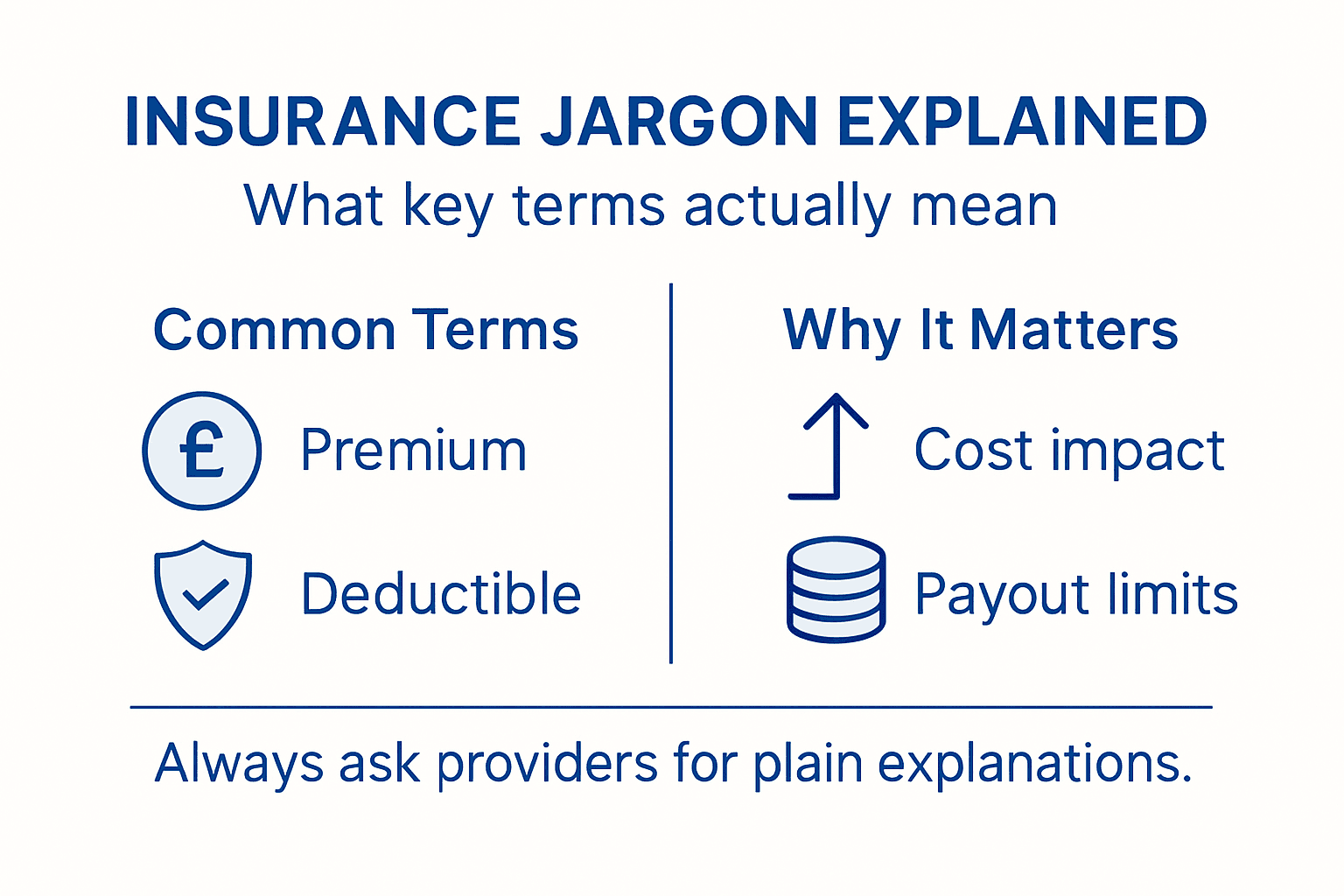
A quick guide to tricky insurance jargon and why misunderstanding can be costly:
| Jargon Term | Financial Impact If Misunderstood | When to Clarify With Insurer |
|---|---|---|
| Pre-existing Condition | Risk of denied health claims | When buying health insurance |
| Named Perils | Limited claim eligibility | Reviewing home or travel policies |
| Aggregate Limit | Claims may exceed maximum payout | High frequency claims scenarios |
| Subrogation | Unexpected loss of compensation | Motor accident claims |
| Exclusion | Coverage gaps leave you exposed | Any new policy or renewal |
Pro tip: Always ask your insurance provider to explain terms in plain language, and request written clarification for any terminology you don’t fully understand.
How to Cut Through Jargon When Comparing
Comparing insurance policies can feel like navigating a linguistic minefield, with technical terms designed to confuse rather than clarify. Plain language approaches can transform this complex process into a more transparent decision-making experience.
To effectively cut through insurance jargon, focus on these key strategies:
- Ask Direct Questions: Request specific explanations for unclear terms
- Translate Technical Language: Convert complex phrases into everyday language
- Compare Core Elements: Prioritise comparing premiums, excess, and key coverage points
- Request Written Clarification: Always get explanations in simple, written form
- Challenge Ambiguous Terms: Don’t accept vague or complicated descriptions
Experts recommend systematic policy comparison that focuses on understanding fundamental coverage elements. The goal is to move beyond intimidating language and extract clear, practical information about what each policy actually provides.
Clarity trumps complexity when making insurance decisions.
Most insurance providers use technical language as a protective mechanism, but consumers have the right to demand straightforward explanations. Understanding the core principles behind these terms can help you navigate policy comparisons more confidently and make more informed choices.
Pro tip: Develop a personal glossary of insurance terms during your research, noting down simplified definitions to help you compare policies more effectively.
Take Control of Insurance Decisions with Clear Comparisons
The challenge of understanding complex insurance jargon can leave you feeling overwhelmed and uncertain about protecting what matters most. Confusing terms like deductible, exclusions, or aggregate limits risk causing costly misunderstandings that affect your coverage and finances. Wise Choice Comparisons recognises these pain points and helps you confidently navigate the confusing insurance landscape by providing clear, unbiased comparisons. Our platform empowers you to cut through the technical language and see the real differences between policies at a glance.

Start making truly informed choices today by exploring our easy-to-use comparison tools. Whether you are searching for better deals on car, home, or life insurance, or simply want to break down insurance jargon into straightforward terms, Wise Choice Comparisons guides you every step of the way. Visit Uncategorized – Wise Choice Comparisons to simplify your insurance journey and secure the best protection for you and your family. Don’t let unclear insurance language hold you back from peace of mind — visit Wise Choice Comparisons now and transform confusion into clarity.
Frequently Asked Questions
What does the term ‘premium’ mean in insurance?
The term ‘premium’ refers to the amount you pay for your insurance policy, typically charged on a monthly or annual basis.
How does a deductible work in an insurance policy?
A deductible is the amount you must pay out-of-pocket for covered expenses before your insurance starts to contribute to the costs.
What is the significance of exclusions in an insurance policy?
Exclusions are specific situations or conditions that are not covered by your insurance policy, and understanding them is crucial to avoid unexpected costs during a claim.
Why is understanding insurance terminology important when comparing policies?
Understanding insurance terminology allows you to decode complex policy documents, making it easier to compare coverage options effectively and choose the best protection for your needs.